
Carnets de route contains information specifically aimed at refugees and refugee claimants, as well as the people assisting them. Carnets de route is intended to help you with the process of settling in when you arrive and during your first few years in Québec.
With Carnets de route, you will enjoy an engaging experience: reliable, organized and accessible information about Québec society, steps to take, to-do lists, timelines, summary diagrams and much more!
Select whether you would like to view the website in English or French, then answer the following three questions to be directed to the right information.

Your profile
Refugee Claims
Accepted Refugee Claims
Refused Refugee Claims
Refugees

Health Care
Key organizations and individuals
1. Updates – Health Care

The content of this section of Carnets de route was updated in November 2025. Some elements may have changed since then. If in doubt, consult the sources and resources in this section. You can also report any information that needs to be changed through Technical Support. Update dates may vary by section.
To-do list
Health Care See the Health Care section of the Carnets de route website to find out how health care services work in Québec and what services to consult depending on your needs
Report a change of address or email as soon as possible: see the Read This Information First section
2. Québec’s health care system
(Collectif Bienvenue, 2023h, 2023h; Gouvernement du Québec, 2022a, 2024c, 2024d, 2026a, 2026b; Jobin-Théberge & Bombardier, 2020b; Ordre des pharmaciens du Québec, s.d.; Services juridiques de Pointe-Saint-Charles et Petite-Bourgogne, 2017; TCRITable de concertation des organismes au service des personnes réfugiées et immigrantes , 2021; Ville de Sherbrooke, 2023e)
2.1 Important facts
In Québec, the health care system is public and most care is available free of charge. Health professionals are well trained and the care is of good quality. However, there are sometimes long wait times to get some types of care, such as non-urgent surgery. This is true for everyone, including Canadian citizens.
2.1.1 Access to health care
- You have access to public health care coverage through the Interim Federal Health Program (IFHPInterim Federal Health Program ). See the corresponding section to find out more.
- You have access to public health care coverage through the Régie de l’assurance-maladie du Québec (RAMQRégie de l’assurance maladie du Québec ) and the Interim Federal Health Program (IFHPInterim Federal Health Program ). See the corresponding sections to find out more.
- Nurses have a wealth of knowledge and can offer a wide range of treatments. Some nurses can prescribe medication and refer you to specialists.
- Pharmacists have a wealth of knowledge, can offer you a pharmacy consultation and can prescribe some common medications.
- It can be difficult to get an appointment at a clinic. See RAMQ IFHP to find out how to make an appointment.
- If you are unable to make an appointment at a clinic, don’t hesitate to talk to your friends, counsellors, etc. These people can share ideas or other options to help you see the right health professional.
- You will not have a family doctor when you arrive in Canada. You must register on a waiting list: Québec Family Doctor Finder The wait times are several years. As a refugee claimant, you are not entitled to a family doctor.
- Dental care in Québec is offered at clinics that are not part of the public health care system. However, for some types of care, public coverage is available, including the IFHPInterim Federal Health Program . See Dental Health for more details.
You may be turned away from your health appointment if you arrive late.
2.1.2 Important clarifications
- Access to care: Your medical results will not influence your immigration status or your access to the care and services you need. For example, people living with HIVHuman immunodeficiency virus or hepatitis C are protected from discrimination in Québec. They have access to the necessary health services.
- Duty of confidentiality: Employees of the health and social services network are not allowed to share information about your health without your authorization, regardless of their job title. See Confidentiality in the Read This Information First section for more details.
- Access to an interpreter: If you do not speak English or French, the health institution can provide an interpreter. If possible, let the institution know in advance that you would like an interpreter. See Interpreters in the Read This Information First section for more details.
- Consent to care for people aged 14 and over: From the age of 14, young people can make their own appointments and attend medical consultations on their own. Young people must generally consent to care by themselves (including contraception). A person aged 14 or over can therefore ask to be alone (without the presence or the consent of their parents or guardian) when seeing a nurse, doctor or counsellor, for example, and can make their own decisions about their health care.
- Abortion: Abortion is available and legal in Québec.
Resources offering abortion services – Government of Québec
Make sure you inform the health institutions you visit of any change of address or contact information (phone or email). For more information, see Change of address and contact information in Read This Information First.
2.1.3 Referrals and prescription drugs
The Québec health care system works on referrals, prescriptions and renewals:

“Here in Canada, you need a referral before going to see a specialist. In our countries, you don’t work with this system of medical referrals.” – Carolina M.
2.1.4 Documents to present
Every time you want to receive care, you must present:
- Your health insurance card Your Refugee Protection Claimant Document/Refugee Protection Identity Document (brown paper) or your Acknowledgement of Claim
- Your vaccination record, if you have one
- Your claim slip (“blue slip”), if you receive social assistance
- Your private health insurance information, if any
2.2 Services based on your needs
In Carnets de route, the term “clinic” is used to refer to family medicine groups (FMGs), local community service centres (CLSCLocal community service centre ) and other health centres for less urgent care (general or specialized). Clinics can be public or private.
Questions about your health
Read more Read lessIf you have a question about your health and whether you should see a doctor or other health professional (for example, you fall on your head, strange spots appear on your skin, you are dealing with grief, etc.):
Services to use:
- 811:
- Info-Santé: call 811, option 1
- Info-Social: call 811, option 2
- 811 is a telephone service that is available 24 hours a day, 7 days a week
- Pharmacies: depending on your needs, pharmacists can offer you a pharmacy consultation or direct you to other health specialists.
Serious emergencies
Read more Read lessIf you have a serious emergency that cannot wait more than a few hours to be treated (for example, a severe allergic reaction, a broken arm, chest pain, difficulty breathing, moving or speaking, suicidal ideation with a plan, etc.).
Services to use:
- 911: For immediate emergency assistance (police, ambulance, fire department, etc.).
- Hospital emergency rooms: Go to the emergency room of the hospital of your choice. If the situation is serious, you will be seen quickly. Waits can be very long for less urgent problems. List of hospitals in Québec: Hôpitaux – Trouver un centre hospitalier (CH) – Index Santé [in French].
All of these services are available 24 hours a day, 7 days a week.
If the situation is very urgent, call 911. If necessary, an ambulance will take you to the hospital. Fees for transportation may apply.
Consultations that are serious but not urgent
Read more Read lessIf you need to:
- See a health professional for health or psychosocial (well-being) problems that are serious, but not urgent
- For example, you have a cold that will not go away or seems to be getting worse
- For example, you are very stressed
- Renew a medication
- Be referred to a specialist
- Access care related to your sexual health, such as contraception or screenings for sexually transmitted and blood-borne infections (STBBIsSexually transmitted and blood-borne infections )
- See a health professional about your lifestyle habits (sleep, nutrition, etc.)
- Get treatment for a wound
Services to use:
- CLSCLocal community service centre : to find the one nearest you, see Finding a CLSC – Répertoire des ressources en santé et services sociaux. Call the selected CLSCLocal community service centre to find out how to make an appointment. If you arrive without an appointment, you may be turned away or have to wait a long time.
- Medical clinics, including FMGs and other clinics: although some medical clinics have a “walk-in” service, the true meaning is more like “quick appointment.” In practice, you generally have to make an appointment to be seen.
- PRAIDAProgramme régional d’accueil et d’intégration des demandeurs d’asile (English: Regional Program for the Settlement and Integration of Refugee Claimants) clinic (Montréal) : call the PRAIDAProgramme régional d’accueil et d’intégration des demandeurs d’asile (English: Regional Program for the Settlement and Integration of Refugee Claimants) nurses at 514-484-7878, extension 64517 and leave a voicemail.
- Pharmacies: pharmacists can provide prescriptions for some minor health conditions (flu, eczema, urinary tract infection, etc.) and for some preventive treatments (vaccination, contraception, etc.). These professionals can also help with medication-related issues like side effects. You can generally make an appointment over the phone or through a pharmacy’s website. Check that the pharmacy is registered as an IFHPInterim Federal Health Program provider first.
To get an appointment at a CLSCLocal community service centre or medical clinic:
- Call 811 and select option 3 to access the Primary Care Access Point.
Tell them that you are a refugee claimant and have no RAMQRégie de l’assurance maladie du Québec health insurance card, so you are unable to get on the waiting list for a family doctor. - Use the Web version of the Primary Care Access Point to be directed to the right service. Primary Care Access Point | Government of Québec. For more information on how to use this tool, see: Finding a Doctor – The Welcome Guide The Web tool also allows you to specify that you do not have a RAMQRégie de l’assurance maladie du Québec health insurance card.
- Use one of the following online appointment platforms:
- Clic Santé: also includes fee-based services. Check that the clinic suggested by the platform accepts the IFHPInterim Federal Health Program .
- Québec Medical Appointment Scheduler
This platform works best if you check it right on the hour (for example, 3 p.m., 4 p.m., 5 p.m., etc.) - Bonjour-santé
- TELUS Health Appointment Access
- The Government of Québec’s Répertoire des ressources en santé et services sociaux (this directory includes private clinics)
- Try calling the clinics directly to make an appointment. Every clinic works differently.
Tests, screenings and samples
Read more Read lessHave you seen a doctor or nurse and received a referral or requisition form for tests (like a blood test, urinalysis or stool sample)?
It is essential to keep this document, since you will need to show it to the staff at your appointments for these tests.
Services to use:
- Local point of service: For some screening tests (for example, COVID-19), urinalysis, stool samples or blood tests, these centres often offer appointments more quickly than clinics. They accept the IFHPInterim Federal Health Program . To make an appointment, call 1-877-644-4545 or visit Clic Santé.
- CLSCLocal community service centre or medical clinic: See “Consultations that are serious but not urgent” above to find out how to make an appointment with these resources.
For radiology or medical imaging services:
If the referral is for radiology or medical imaging, you can:
- Find the radiology or medical imaging service at the hospital nearest you and call the number displayed. For some hospitals, you can fill out an online form to make an appointment. To find the hospital nearest you: Other resources – Répertoire des ressources en santé et services sociaux
- Check the Clic Santé website to find a clinic that offers these services. There are options available free of charge or for a fee. Check that the clinic suggested by the website accepts the IFHPInterim Federal Health Program .
Pregnancy and early childhood
Read more Read lessIf you are pregnant and/or you have a very young child (aged 0–5) and need one of the following: pregnancy follow-up, prenatal workshops, postnatal follow-up, breastfeeding support, vaccinations, etc.:
Services to use:
- “Ma grossesse” service: Sign up for the “Ma grossesse” service for pregnancy follow-up and information about services offered in multiple languages: Ma grossesse service | Government of Québec
- CLSCLocal community service centre : Health and psychosocial follow-up during pregnancy and after giving birth Finding a CLSC – Répertoire des ressources en santé et services sociaux
- La Maison Bleue (Greater Montréal): Support and perinatal services for pregnant people and families with children aged 0–5 Contact – La Maison Bleue
- Perinatal resource centres (CRPs): Prenatal workshops, activities, home support after giving birth, etc. Find your local CRP – Réseau des CRP du Québec
- Birth centres: Pregnancy follow-up during and after childbirth, provided by midwives Répertoire des maisons de naissances au Québec – Regroupement Les sages-femmes du Québec [in French]
- PRAIDAProgramme régional d’accueil et d’intégration des demandeurs d’asile (English: Regional Program for the Settlement and Integration of Refugee Claimants) : Call the PRAIDAProgramme régional d’accueil et d’intégration des demandeurs d’asile (English: Regional Program for the Settlement and Integration of Refugee Claimants) at 514-484-7878, extension 64517 and leave a voicemail
For more information about contraception or an unplanned pregnancy, see Reproductive health.
Specialists
Read more Read lessIn Québec, certain health problems are treated by specialist physicians. This is the case, for example, for surgery, dermatology, complex illnesses, etc.
Services to use:
To see a specialist doctor, you will need a referral from a general practitioner or specialized nurse practitioner. See “Consultations that are serious but not urgent” to find out how to make an appointment with a general practitioner or specialized nurse practitioner.
Note that it can take a long time to get an appointment with a specialist.
Specialized care
Read more Read less
From May 1st, 2026, you will have to pay 30% of the cost for specialized care, while the IFHPInterim Federal Health Program will pay for the remaining cost. For example, if the care costs $100, you will have to pay $30.
This includes care provided by physiotherapists, psychologists, dentists, optometrists, etc.
Services to use:
Many types of specialized medical care are available at specialized clinics. For people covered by the IFHPInterim Federal Health Program , only dental and eye care are available without a referral from a doctor or nurse. For other services, the IFHPInterim Federal Health Program requires a medical referral to pay the associated costs. If you no longer have access to the IFHPInterim Federal Health Program , no medical referral is necessary.
The services offered vary from clinic to clinic: it is best to contact them directly to check. These services are also available at private clinics.
You may have to pay the entire cost of the service if you are no longer covered by the IFHPInterim Federal Health Program
and the service is not covered by private insurance.
Medication
Read more Read lessFrom May 1st, 2026, you will have to pay $4 to obtain or renew a prescribed medication. The remaining cost will be paid by the IFHP. For example, if your doctor prescribed three medications, you would need to pay $12 to obtain them.
Some medications can be obtained without a doctor’s prescription, while others must be prescribed for you.
Services to use: pharmacies
Before going there, contact the pharmacy to check whether it accepts medical prescriptions from people covered by the IFHPInterim Federal Health Program . For more details, see IFHP.
Vaccination
Read more Read lessMany vaccines are available in Québec free of charge. For other vaccines, you have to pay.
For adults and children aged 0–5, you need to make an appointment to get vaccinated.
School-aged children (aged 5+) can receive priority vaccines at school during vaccination campaigns. The school will inform parents if a campaign is being organized.
To find out which vaccines are offered free of charge: Recommended immunization schedule – Government of Québec
Services to use:
- Local point of service: These centres often offer appointments more quickly than clinics. They accept the IFHPInterim Federal Health Program . To make an appointment, call 1-877-644-4545 or look for an available time slot on the Clic Santé website.
- Pharmacy: Some vaccines are available at pharmacies. This service may be available free of charge or for a fee. You can generally make an appointment over the phone or through a pharmacy’s website. Check that the pharmacy is registered as an IFHPInterim Federal Health Program provider first.
- CLSCLocal community service centre : See “Consultations that are serious but not urgent” above to find out how to make an appointment with these resources.
Private fee-based clinics
Read more Read lessYou can also receive health services from private clinics, which will charge you for the care you receive. This is generally expensive.
2.3 Service resources based on your needs
Info-Santé 811
Info-Social 811
911
Available 24/7 – For immediate emergency assistance (police, ambulance, fire department, etc.)
List of hospitals in Québec
Finding a CLSCLocal community service centre – Government of Québec
Ma grossesse service – Government of Québec
Multilingual – Pregnancy follow-up, support and information
La Maison Bleue
Greater Montréal – Support and perinatal services for pregnant people and families with children aged 0–5
Find a perinatal resource centre – Réseau des CRP du Québec
Information for future parents and parents of children aged 0–2
Directory of birth centres in Québec – Regroupement Les sages-femmes du Québec
To get an appointment at a CLSCLocal community service centre or medical clinic:
Book a medical appointment – Clic Santé
Répertoire de ressources en santé et services sociaux – Government of Québec
3. IFHP
(CERDACentre d’expertise sur le bien-être et l’état de santé physique des réfugiés et des demandeurs d’asile et al., 2023; Collectif Bienvenue, 2023h; Croix Bleue Medavie, 2016; IRCCImmigration, Refugees and Citizenship Canada , 2023o, 2025l; Jobin-Théberge & Bombardier, 2020b; TCRITable de concertation des organismes au service des personnes réfugiées et immigrantes , 2021; Trosseille et al., 2019)
3.1 How the IFHPInterim Federal Health Program works

You are automatically covered by the IFHPInterim Federal Health Program as soon as you arrive in Québec as soon as you submit your refugee claim, and you do not have any steps to take.
From May 1st, 2026, you will have to pay 30% of the cost for care included in the additional coverage, while the IFHPInterim Federal Health Program will pay for the remaining cost. For example, if the care costs $100, you will have to pay $30. Care included in the basic coverage will continue to be 100% paid by the IFHPInterim Federal Health Program .
Also, if you do not have your RAMQRégie de l’assurance maladie du Québec card yet, you will have to pay $4 to obtain or renew a prescribed medication. The remaining cost will be paid by the IFHPInterim Federal Health Program . For example, if your doctor prescribed three medications, you would need to pay $12 to obtain them.
When you arrive in Québec, you must wait to receive your health insurance card before being covered by the RAMQRégie de l’assurance maladie du Québec . During this period, you are covered by another type of coverage called the IFHPInterim Federal Health Program .
Once you have received your RAMQRégie de l’assurance maladie du Québec health insurance card, and during your first year in Québec, you will still be covered by the IFHPInterim Federal Health Program for certain additional services. For example, you have access to a psychologist, a physiotherapist, a dentist, an optometrist and mobility aids.
You will receive an IFHPInterim Federal Health Program eligibility document when you arrive at the airport. If you do not receive it, follow these instructions: Guide 5568 – Application for Interim Federal Health Program Coverage (IFHP) – Canada.ca.
Your host organization or sponsorship group will help you find specialists that accept the IFHPInterim Federal Health Program . If you are unable to find one, you may have to go to private clinics that do not accept the IFHPInterim Federal Health Program and pay for some types of care yourself.
As a refugee claimant, you are covered by the IFHPInterim Federal Health Program throughout the refugee claim process. You can use your Refugee Protection Claimant Document/Refugee Protection Identity Document or your Acknowledgement of Claim to have these services covered.
You are not covered by the RAMQRégie de l’assurance maladie du Québec , which is the public health insurance plan for most people in Québec.
Only health professionals registered as IFHPInterim Federal Health Program providers with Medavie Blue Cross can provide you with services free of charge. Health professionals who are not registered have the right to refuse you care or charge you for costs. A small minority of clinics accept the IFHPInterim Federal Health Program .
The IFHPInterim Federal Health Program is not always well understood by health professionals. You may have to explain what the IFHPInterim Federal Health Program is in some places and insist on receiving care. However, hospital emergency rooms are required to provide care.
IFHPInterim Federal Health Program Toolkit – CERDACentre d’expertise sur le bien-être et l’état de santé physique des réfugiés et des demandeurs d’asile
Do not pay for IFHPInterim Federal Health Program -covered care out of your own pocket, as you will not be reimbursed.
3.2 Steps to follow to access health care
If you need to go to the hospital emergency room
Read more Read lessGo there directly. All hospitals must accept people covered by the IFHPInterim Federal Health Program .
If you would like to go to a clinic or CLSCLocal community service centre or receive a specialized service
Read more Read lessCall ahead to check whether the clinic accepts the IFHPInterim Federal Health Program , since few clinics accept it. CLSCs accept the IFHPInterim Federal Health Program , but this coverage is less well known and you may need to explain it.
If you would like receive a specialized service
Read more Read lessCall ahead to check whether the clinic accepts the IFHPInterim Federal Health Program , since few clinics accept it.
Once you arrive
Read more Read lessIf you have your Refugee Protection Claimant Document/Refugee Protection Identity Document, show this at the desk.
If you do not have your Refugee Protection Claimant Document/Refugee Protection Identity Document yet, show your Acknowledgement of Claim and indicate your UCIUnique client identifier number. This document proves that you are in the process of obtaining a Refugee Protection Claimant Document/Refugee Protection Identity Document and are therefore covered by the IFHPInterim Federal Health Program .
Show your IFHPInterim Federal Health Program eligibility document.
There are two possible scenarios:
- You receive the services free of charge.
- The clinic refuses to give you free care.
If the clinic refuses to give you free care
Read more Read less- Do not pay
- Here are your options:
- Try another clinic
- Call 811, option 3 to find out which clinics accept IFHPInterim Federal Health Program coverage
- If you wish, you can file a complaint with a local service quality and complaints commissioner if the professionals are registered with the IFHPInterim Federal Health Program .
Finding a Doctor – The Welcome Guide – Welcome Collective
Greater Montréal – List of medical clinics that accept IFHPInterim Federal Health Program coverage
Health Passport- The Refugee Centre
You can also inform your host organization call the PRAIDAProgramme régional d’accueil et d’intégration des demandeurs d’asile (English: Regional Program for the Settlement and Integration of Refugee Claimants) if you have problems accessing care: 514 484-7878, extension 5 or extension 64517.

The IFHPInterim Federal Health Program is not well known. In addition, access to care can be even harder to get outside Montréal. Don’t hesitate to contact a counsellor or the PRAIDAProgramme régional d’accueil et d’intégration des demandeurs d’asile (English: Regional Program for the Settlement and Integration of Refugee Claimants) for help.
Local Service Quality and Complaints Commissioner at health facilities
File a complaint if you experience discrimination, are refused treatment or receive inadequate care from a health facility like an FMGFamily medicine group , a hospital or a CLSCLocal community service centre .
3.3 Steps to follow to access prescription drugs
If you have just arrived and have not received your health insurance card yet, follow these steps:
- Consult a doctor or nurse for a prescription.
- If you have a prescription for a drug or a refill, pick it up at a pharmacy.
- Find a pharmacy that accepts the IFHPInterim Federal Health Program . It is best to call ahead to check.
- Bring the following documents with you:
- Your prescription
- Your Refugee Protection Claimant Document/Refugee Protection Identity Document or your Acknowledgement of Claim, mentioning that you are covered by the IFHPInterim Federal Health Program
- Your IFHPInterim Federal Health Program eligibility document
- The vast majority of prescription drugs are covered. Your pharmacist can confirm whether your prescribed medication is covered.
If the drug is not covered by the IFHPInterim Federal Health Program , the pharmacist can sometimes offer an equivalent drug. Otherwise, you will have to pay for the prescribed medication. - If the drug is covered by the IFHPInterim Federal Health Program :
3.4 Services covered by the IFHPInterim Federal Health Program
(Croix Bleue Medavie, 2022; Régie de l’assurance maladie, s. d.-d)
Basic coverage
Read more Read less- Hospital services
- Physician services
- Laboratory, diagnostic and ambulance services
- Limited ambulance transportation costs
- Limited midwife services
Additional coverage
Read more Read less
From May 1st, 2026, you will have to pay 30% of the cost for care included in the additional coverage, while the IFHPInterim Federal Health Program will pay for the remaining cost. For example, if the care costs $100, you will have to pay $30.
- Limited dental care. See Dental health for more details.
- Limited vision care
- Limited home care and long-term care at a public or private institution (for example, a CHSLDLong-term care centre , which is a centre for seniors who require constant care)
- Services provided by specialists, including psychologists, occupational therapists, speech therapists and physiotherapists
- Aids to daily living, medical supplies and equipment
Prescription drug insurance
Read more Read less- Prescription drugs and other products listed on provincial drug formularies. Note that having prescription drug coverage is mandatory in Québec (either with the IFHPInterim Federal Health Program , the RAMQRégie de l’assurance maladie du Québec or private coverage).
From May 1st, 2026, if you do not have your RAMQRégie de l’assurance maladie du Québec
card yet, you will have to pay $4 to obtain or renew a prescribed medication. The remaining cost will be paid by the IFHP. For example, if your doctor prescribed three medications, you would need to pay $12 to obtain them.
Coverage for the IMEImmigration medical exam
Read more Read lessIMEImmigration medical exam and related diagnostic tests
This table is inspired by and adapted from the CERDACentre d’expertise sur le bien-être et l’état de santé physique des réfugiés et des demandeurs d’asile infographic “The IFHPInterim Federal Health Program : Important to Know,” CERDA: The IFHP: Important to Know
If you have private insurance with your job or post-secondary institution, what is covered by that insurance will not be covered by the IFHPInterim Federal Health Program .
4. Wellness and mental health
(CERDACentre d’expertise sur le bien-être et l’état de santé physique des réfugiés et des demandeurs d’asile , 2022; Cleveland, Hanley, Salamanca Cardona, Manuel, et al., 2021; Trosseille et al., 2019)
“You put your life on hold until your status is settled. You’re trying to recreate a new life here. You find yourself facing challenges you never expected. There are situations in life that are difficult, like when you’re ill, you find yourself alone, there’s no one to help you or you have no ties. So it’s very important to seek help when we need it, and to take care of our mental health whenever possible.” – Mariam
Many people arriving in Québec face major challenges. It is normal for the many difficulties associated with your migration experience (fleeing your home country, waiting and adjusting to a new one) to affect you. You may feel sad, stressed, distressed, depressed, tired, etc. You may also experience challenging things such as uncertainty, feeling like you are losing your connection to your culture of origin, loneliness, lower self-esteem, anger, etc.
If these challenges are familiar to you, keep in mind that other people also experience these emotions and difficulties when they arrive in Québec. It is normal to react to obstacles and changes, experience challenging emotions and have negative thoughts after these events. Help is available.
“For people with psychological disorders, it’s important to have access to mental health resources. The process to settle in is hard, and you have to be in a good mental state.” – Bernadette
If you feel the need to receive assistance and talk to someone about it, you can make an appointment with a professional. Just like there are physical health professionals, there are also professionals who specialize in mental health and well-being (psychologists, social workers, psychoeducators, therapists, psychiatrists, etc.).
Community organizations and your sponsorship group can help you obtain support services. The Info-Social phone line (811, option 2) can also direct you to the right services. In addition, some community groups offer specialized well-being and mental health support. You can also be accompanied to a doctor and/or CLSCLocal community service centre to get a referral or specialized care.
The IFHPInterim Federal Health Program covers the first 10 one-hour psychotherapy sessions if you have a referral from a doctor. You will then need to get a new referral from a doctor to extend your psychotherapy, and your psychologist or psychotherapist will need to ask Medavie Blue Cross for authorization.
Some types of care may be offered in the private sector. Make sure the professional accepts IFHPInterim Federal Health Program coverage or your private coverage.
Intervention network for persons affected by organized violence (RIVOIntervention network for persons affected by organized violence )
Mental health services for people covered by the IFHPInterim Federal Health Program , by referral only and with a medical prescription
Maison Multiethnique Myosotis
CAP santé mentale
Support, tools and grouping of organizations for loved ones of people with mental health issues
211
Multilingual phone line (over 200 languages) – Information and referral service for social and community services
Suicide prevention
Find a crisis centre – Regroupement des services d’intervention de crise du Québec
“You’re not alone here. There are people who are ready to help you, even if you know little or nothing about them. Don’t hesitate to ask these people for questions and help.” – Mariam
5. Dental Health
(Croix Bleue Medavie, 2022a, 2024; Gouvernement du Canada, 2026; Régie de l’assurance-maladie, s.d.–f; Robert, 2015)
In Québec, most dental care is offered at private clinics. However, public coverage is available to receive some care free of charge or at a lower cost.
The following public coverage is available:
Some people may be eligible for more than one type of coverage at the same time.
Some jobs offer private dental insurance.
5.1 Differences between each type of public coverage
Each type of coverage has its own rules: who is eligible, what care is covered, how to register, etc.
Read this section to check what types of coverage you are entitled to.
5.1.1 RAMQRégie de l’assurance maladie du Québec
RAMQRégie de l’assurance maladie du Québec dental coverage varies by age. Special coverage is available for children under 10. If your child was born in Québec, they have access to the RAMQRégie de l’assurance maladie du Québec .
It is up to the hospital or dental clinic to apply for reimbursement from the RAMQRégie de l’assurance maladie du Québec . Simply present your RAMQRégie de l’assurance maladie du Québec health insurance card at the reception desk of the hospital or dental clinic when you arrive for your appointment.
For more information on how to register for the RAMQRégie de l’assurance maladie du Québec , see 4. RAMQ. see 6. Coverage for children
Before and during your appointment, always ask staff what care is covered to avoid unexpected bills.
If the care is covered by the RAMQRégie de l’assurance maladie du Québec
, the clinic or hospital is not allowed to charge you extra fees for that specific care. However, your dentist may recommend additional steps or care that is appropriate, but not covered by the RAMQRégie de l’assurance maladie du Québec
. In this situation, if you do not have access to other coverage, you will need to pay for this care or refuse it.
5.1.2 IFHPInterim Federal Health Program
From May 1st, 2026, you will have to pay 30% of the cost for care included in the dental coverage, while the IFHPInterim Federal Health Program will pay for the remaining cost. For example, if the care costs $100, you will have to pay $30.
Like for other types of care, always check that your dentist is registered as an IFHPInterim Federal Health Program provider when you make an appointment.
If pre-authorization is required for care, the clinic or hospital will take the necessary steps with the IFHPInterim Federal Health Program . In this case, it is normal to have to wait before receiving care.
It is up to the dental clinic or hospital to apply for reimbursement. Do not pay for care covered by the IFHPInterim Federal Health Program yourself. Simply present your Refugee Protection Claimant Document/Refugee Protection Identity Document and provide your UCI number. You must only present your IFHPInterim Federal Health Program eligibility document.
For more information on how the IFHPInterim Federal Health Program works, see 3. IFHP. see, 5. IFHP.
Before and during your appointment, always ask staff what care is covered to avoid unexpected bills.
If the care is covered by the IFHPInterim Federal Health Program , the clinic or hospital is not allowed to charge you extra fees for that specific care. However, your dentist may recommend additional steps or care that is appropriate, but not covered by the IFHPInterim Federal Health Program . In this situation, if you do not have access to other coverage, you will need to pay for this care or refuse it.
5.1.3 Canadian Dental Care Plan
The Canadian Dental Care Plan is a program that was launched in 2025. It allows people who are eligible to receive care at a lower cost.
Many clinics are registered to provide care covered by the Canadian Dental Care Plan, but not all of them are. Check that the clinic participates in the program before making an appointment.
To be eligible for this coverage:
- You must not have access to private dental insurance (for example, through your job).
- You must have filed a tax return in Canada for the previous fiscal year.
- If you have a spouse or common-law spouse, they must also have filed a tax return in Canada for the previous fiscal year.
- The total annual income for you and your spouse or common-law spouse must not be more than $90,000.
If you are eligible, you must register for the Plan to be able to use it. It is recommended that you register as soon as possible and not wait for an appointment or a dental emergency, since there will be a waiting period.
To maintain your coverage, you must renew your registration every year by June 30.
Information to register:
- Your SINSocial insurance number (not required for children)
- The list of types of coverage you are eligible for, like the IFHPInterim Federal Health Program
- Your notice of assessment for your Canadian tax return for the previous fiscal year
To register, use one of these options:
Online
Complete the form available at: Canadian Dental Care Plan – Apply – Canada.ca
Via My Service Canada Account
If you have a My Service Canada Account, you can click on the “Canadian Dental Care Plan” section of the dashboard to access the information to register.
By phone
1-833-537-4342
After you register, you will receive a card in the mail proving that you are registered with the Plan. You must present this card at the clinic.
Generally, the Plan only covers part of the cost of care. The amount you have to pay varies based on your income. To find out more, see: Canadian Dental Care Plan – What services are covered – Canada.ca
It is up to the dental clinic to request reimbursement from the Plan. You should not pay for care covered by the Plan yourself.
The Canadian Dental Care Plan sets a maximum amount for each covered service. Clinics may charge you more than this amount. If so, you will need to pay the difference yourself.
Before making an appointment, contact the clinic to check what amounts are covered by the Plan and if you will have to pay an additional amount. Since there may be unexpected expenses during the appointment, try to budget accordingly.
5.2 Covered care by coverage type
Different types of public coverage cover different types of care. This impacts what professionals can provide you with care and how much the care costs. If you are eligible for more than one type of coverage, they apply in a certain order.
If the priority coverage does not cover the care you need, you must proceed to the next type of coverage.
The order of priority is:
RAMQRégie de l’assurance maladie du Québec
IFHPInterim Federal Health Program
Canadian Dental Care Plan
For example, a cleaning is not covered by the IFHPInterim Federal Health Program (or by the RAMQRégie de l’assurance maladie du Québec if your child has access to it). However, this care is covered by the Canadian Dental Care Plan. This means that your dentist can make a claim under this coverage.
If your child has access to the RAMQRégie de l’assurance maladie du Québec , check first if the care is covered by the RAMQRégie de l’assurance maladie du Québec . If not, then check if the Canadian Dental Care Plan can cover it.
For example, you need to fix a cavity that is hurting you. This care is not covered by the RAMQRégie de l’assurance maladie du Québec , but it is covered by the IFHPInterim Federal Health Program . This means that your dentist must make a claim under this coverage. If you no longer have access to the IFHPInterim Federal Health Program , your dentist must make a claim under the Canadian Dental Care Plan to cover this care.
Another example: you want to get a cleaning. This is not covered by the RAMQRégie de l’assurance maladie du Québec or the IFHPInterim Federal Health Program , but it is covered by the Canadian Dental Care Plan. This means that your dentist must make a claim under the Plan.
5.2.1 Types of care covered by coverage type
The following table shows examples of care that is covered. Other care may also be covered. If in doubt, check with your dental clinic.
If you are receiving social assistance, the specific coverage that applies to you is not included in this table. For more details, see 7.1.4. Coverage for people receiving social assistance.
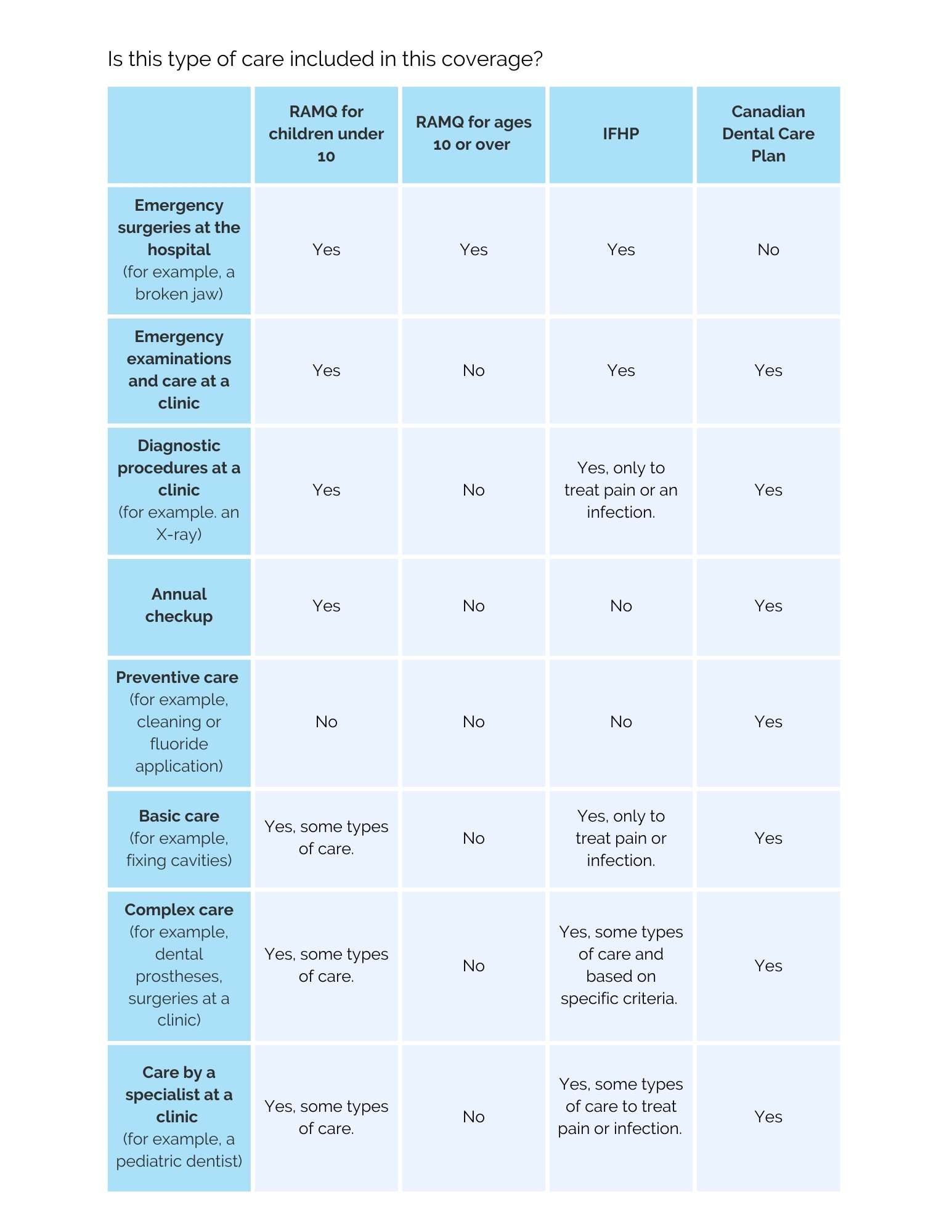
It is recommended that you compare rates at several clinics before making an appointment, since they can vary.
6. Health for 2SLGBTQIA+ people
(AGIR Montréal, 2023; Collectif Bienvenue, 2023h; Éducaloi, 2023j; Rainbow Response Coalition et al., 2012)
6.1 Medical resources

You can consult a CLSCLocal community service centre to receive care and services and to be referred to organizations for 2SLGBTQIATwo-spirit, lesbian, gay, bisexual, trans, queer, intersex, asexual and additional sexual orientations and gender identities + people.
Finding a CLSCLocal community service centre – Government of Québec
Find a screening clinic for 2SLGBTQIATwo-spirit, lesbian, gay, bisexual, trans, queer, intersex, asexual and additional sexual orientations and gender identities + people
6.2 Hormones and surgeries
You can get access to hormones and gender-affirming surgeries. However, the process is complex.
The RAMQRégie de l’assurance maladie du Québec covers the costs of some hormones and surgeries. The IFHPInterim Federal Health Program covers the cost of some hormones, but not surgery.
If you would like more information about access to hormones and gender-affirming surgeries, contact AGIR Montréal.
AGIR Montréal
Multilingual – Support for LGBTQIA+ migrants
7. Reproductive Health
(Croix Bleue Medavie, 2022b ; Fédération du Québec pour le planning des naissances, s.d.; Gouvernement du Québec, 2024e, 2025h)
Reproductive health includes reproduction and fertility.
7.1 Contraception
Many contraception options are available in Québec depending on your needs. Some options, like the oral contraceptive pill and the hormonal IUD, are covered by the IFHPInterim Federal Health Program . by the RAMQRégie de l’assurance maladie du Québec . Other options, like the copper IUD and condoms, are not covered.
You can consult these resources to find out more:
It’s a plan – Society of Obstetricians and Gynaecologists of Canada
Contraception- Fédération du Québec pour le planning des naissances
To understand contraception, its advantages and disadvantages and the cost in Québec. For everyone, including 2SLGBTQIATwo-spirit, lesbian, gay, bisexual, trans, queer, intersex, asexual and additional sexual orientations and gender identities + people.
To use a method of contraception that requires a prescription, or if you have questions, see a health professional.
Services to use:
- Pharmacy: Pharmacists can prescribe some hormonal methods of contraception. You can generally make an appointment over the phone or through a pharmacy’s website. Check that the pharmacy is registered as an IFHPInterim Federal Health Program provider first.
- Medical clinic:
- Call 811 and select option 3 to access the Primary Care Access Point. Tell them that you are a refugee claimant and have no RAMQRégie de l’assurance maladie du Québec health insurance card, so you are unable to get on the waiting list for a family doctor.
- Use the Clic Santé platform to make an appointment.
7.2 Emergency contraception
Emergency contraception is used to avoid pregnancy after unprotected or inadequately protected sex (for example, if the condom breaks).
The most common method is the “morning-after pill.” It can be taken orally up to five days after sex, but is more effective if taken sooner.
The price of the medication is covered by the RAMQRégie de l’assurance maladie du Québec . by the IFHPInterim Federal Health Program .
Services to use:
- Pharmacy with or without an appointment: You can generally make an appointment over the phone or through a pharmacy’s website. Check that the pharmacy is registered as an IFHPInterim Federal Health Program provider first.
7.3 Unplanned pregnancy
If you are pregnant, you have three options:
- Continue with your pregnancy
- Continue with your pregnancy and place the child for adoption
- End your pregnancy (abortion)
In Canada, from the age of 14, only the pregnant person can decide to continue with or end their pregnancy.
If you are unsure what decision to make, you can consult reliable and non-judgmental resources:
SOS Grossesse
For reliable and non-judgmental answers to your questions about an unplanned pregnancy
Anywhere in Québec
SOS Grossesse Estrie
For reliable and non-judgmental answers to your questions about an unplanned pregnancy
For residents of Estrie
Grossesse Secours
For reliable and non-judgmental answers to your questions about an unplanned pregnancy
Anywhere in Québec
Abortion is legal and available in Québec at any stage of pregnancy. The cost is covered by the RAMQRégie de l’assurance maladie du Québec . by the IFHPInterim Federal Health Program .
Obtaining abortion services – Government of Québec
Information about abortion services, including a directory of clinics that offer these services.
Adoption in Québec – Government of Québec
For more information about resources to use during pregnancy, see the relevant point in 2.2. Services based on your needs.
7.4 Fertility
Fertility treatments are not covered by the IFHPInterim Federal Health Program .
Costs can be very high without medical coverage.
To find out more about medically assisted reproduction services in Québec: How to receive medically assisted reproduction services | Government of Québec
If you are experiencing fertility issues, you can consult health professionals.
The RAMQRégie de l’assurance maladie du Québec covers fertility-related care under certain criteria, for example through its Medically Assisted Reproduction Program. A medical referral is required to access it.
To find out more, see: Medically assisted reproduction program | Government of Québec
8. Sexual Health
(Gouvernement du Québec, 2025i; Info-aide violence sexuelle, s.d.; Ordre professionnel des sexologues du Québec, s.d.; World Health Organization, s.d.)
Sexual health includes the physical and psychological elements of sexuality. If you have questions or concerns about your sexual health, health professionals can help you or direct you to the right resources.
For example, in Québec, sexologists are specialized professionals who can help you improve or maintain your sexual health. They can assess your situation and provide or recommend interventions or treatments. Their services are not covered by the IFHPInterim Federal Health Program or the RAMQRégie de l’assurance maladie du Québec . To find a sexologist in private practice, see the Ordre professionnel des sexologues du Québec directory: https://www.opsq.org/fr/trouver-votre-sexologue/organization [in French]
Sex & U
8.1 Sexually transmitted and blood-borne infections (STBBIsSexually transmitted and blood-borne infections )
Sexually transmitted and blood-borne infections (STBBIs) can be transmitted:
- During sex without physical protection (for example, a condom or dental dam)
- Through contact with blood
- From mother to child during pregnancy or childbirth
Some people with STBBIsSexually transmitted and blood-borne infections do not show any symptoms. Getting screened is the only reliable way to detect an STBBI, receive treatment, prevent complications and avoid transmitting the infection. It is confidential, simple and quick.
From the age of 14, it is possible to have a screening test, get the results and be treated without informing the parents.
Screening services are covered by the RAMQRégie de l’assurance maladie du Québec . by the IFHPInterim Federal Health Program .
To find out more about STBBIsSexually transmitted and blood-borne infections and screenings: Transmission of sexually transmitted and blood-borne infections (STBBIs) | Government of Québec
To make a screening appointment:
- Call 811 and select option 3 to access the Primary Care Access Point. Tell them that you are a refugee claimant and have no RAMQRégie de l’assurance maladie du Québec health insurance card, so you are unable to get on the waiting list for a family doctor.
- Use the Clic Santé online platform.
8.2 Sexual violence
If you have experienced sexual violence, you can ask a community counsellor, a health professional and/or the police for help.
To talk to health professionals trained to support people who have experienced sexual violence, call 811 to be directed to the right resources.
Info-Santé 811
Sexual Violence Helpline
Available 24/7 – Help if you experience sexual violence – phone and chat
CALACSCentre d’aide et de lutte contre les agressions à caractère sexuel (Centre for help and prevention against sexual assault)
Directory to find support if you experience sexual violence (women and gender-diverse people)
9. For more information
Canadian Orientation Abroad Participant Workbook – IOM
Multilingual
Participant workbook: Canadian Orientation Abroad Participant Workbook – IOM
“O Canada – conversations dialogue” audio guide: Canadian Orientation Abroad: O-Canada Conversations
“O Canada” mobile application: O Canada – App Store
For additional information and exercises on many aspects of this Carnets de route section, see the “Health” chapter, pages 93 to 106, of the Canadian Orientation Abroad “Participant’s Workbook”.
You can also listen to the “O Canada – Conversations Dialogue” audio guide and download the “O Canada” application.